

Flatville: Where they've come from and where they're going
Updated: Feb 12
By Julia Schultz
Flatville is potentially the most unassuming name for a town. Whether it’s a faux location used on improv night, the sunshine street used in a children’s cartoon, or the first name that comes to mind when giving an overeager tourist the name of your hometown – Flatville may appear to be the John Doe of villages.
While calling Flatville home is not something that many people can say, those who can are residents in a town that is rich in German and Lutheran heritage. And perhaps Flatville was a fitting name, for the 150-foot spire of the Lutheran cathedral that was built amid the fields can be seen for miles along the flat prairie. Understanding the history of the community, the history of the church, the traditions, and the impact the town/church has on its community members is key to understanding the complete history of a small town in East Central Illinois.
Establishment of Flatville
When German immigrants landed on the East Coast, it was a journey to arrive in Illinois. Nonetheless, they arrived in wagons in Illinois. As the Germans were contemplating settling in Flatville, an obvious problem came to their attention …Flatville was an unincorporated swampland. So, three men from Golden went into the swamps with three wagons. “‘How we prayed for a freeze that night,' one of them said. They waited around until eleven o’clock at night before the ground was solid enough to bear the weight of the [wagons]."(1) When the three German men saw the promise of the rich land, albeit covered in a swamp, they set up a settlement, and “the three were soon joined by their families and fellow countrymen, mostly from East Frisia in Germany.”(2)

Fig 1: Populated Prime Famland Class
Soils of Illinois
The German immigrants had come a long way, and by digging up the swamp, the men were able to uncover the rich soil that Flatville had to offer. Unfortunately, draining the swamp was slow and backbreaking labor, as the land and water had to be excavated by hand. Mohel states how, “the early settlers [tell] how they actually sloped acre after acre toward the ditches they had dug with spades and horse-drawn scoops.”(3) The tumultuous work was well rewarded, as Flatville continues to have extremely fertile and profitable farmland, as seen in Figure 1.(4) According to Zilis, the settlers set up the drainage system that still exists in the present day. This drainage system helped the farmers with their land and the community members, because it allowed them to build on the land. (5) The Flatville settlement paved the way for their fellow countrymen. As the soil’s richness became more and more well-known, it attracted people looking for a promising career, and by "1850, there were thirty-eight thousand Germans in Illinois." (6)
Church History
Fairly quickly, the people of Flatville felt the need to establish their religious roots in the now-fertile land. The German immigrants were Lutherans. People of the Lutheran faith are Christians who follow the teachings of Martin Luther and the Lutheran Confessions. (7) Both are very important to the Protestant schism from the Catholic church. So, the citizens of Flatville formed a congregation. Reverend Alton Zenker thinks that “the congregation probably existed for at least two years before it was decided to build a church in 1874.”(8)
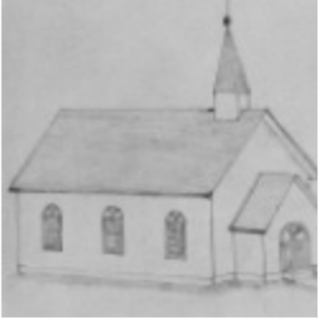
Fig 2: Sketch of the 1874 Church
The early settlers were led by a man called Pastor Grupe.(9) Grupe was a traveling pastor who ministered to the Champaign area, so unofficially, he was the first pastor in Flatville. Corner states, “during the first years of the settlement, services were held in one of the homes. Later, a small building was erected, and a traveling preacher who served Rantoul, Paxton, and other places preached and held Eucharistic service every six weeks."(10) The traveling preacher referred to Pastor Grupe. The congregation was split sometime between 1872 and 1874. On June 15, 1874, a part of the split congregation decided that they wanted a full-time pastor. Rev. G.H. Fischer filled that role and was the first full-time pastor that the church had.(11)
After Rev. Fischer, Rev. Friedrich Ave-Lallemont was the next full-time pastor. Rev.
Lallemont caused several issues for the congregation. Half the congregation supported him, and the other half didn’t. This disagreement caused the congregation to split. There were many theories as to why the congregation split, but the most popular idea was the fact that Rev. Ave-Lallemont “insisted on having his brother as a teacher at the school, but his brother was wanted for murder somewhere in the East.”(12) Both parties – for and against Rev. Ave-Lallemont – wanted to claim the property that their church was situated on. The part of the congregation against the Rev. won the land, and the 19 families that endorsed the Rev. formed a new congregation.(13)

Fig 3: Second Lutheran Church
On April 26, 1886, the new, freshly split congregation decided to build a new church.(14) While this church had a slender steeple and was a grand improvement, architecture-wise from the first small church, this still wasn't the final church, nor the church that was famous for its steeple. The second church had issues of its own, mainly with location and architecture. So, in 1913, the congregation elected to build a third - and final - church. Construction began in 1913, the cornerstone was laid in 1914, and in 1915, the famous church was ready for dedication.(15)
It's important to note that more than the physical building changed throughout the years regarding the Immanuel Lutheran Church of Flatville. There are several changes made from the church to the church now. One of the most prominent changes was the language of the church. From the first service until 1939, the church services were given in the German Plattdeutsch dialect. After 1932, there was an introduction of English services – or ‘American Services’ – and this system was enacted until 1962 when German services ended altogether.(16)
Another change was women’s roles in the church. In the early days of the church, it appears that women played a more traditional role. They were the homemakers, wives, mothers, daughters, and sisters. Additionally, according to Hinton, “women were not allowed to vote on the church constitution.”(17) However, as the years passed, women had a more substantial role in the church community. In A Century of God’s Presence, four women are pictured in black-and-white as being part of a Centennial Committee; however, the year that the photograph was taken was not specified. And as time went on, eventually women would be a Visitation Paster and there would also be a female Associate Pastor at the church. Paster Barbara Busboom was the Visitation Paster in 2005, and Paster Synthia A. Bisser served at Immanuel Lutheran Church from 2014-2017.(18) A Visitation Pastor works closely with the members of a church body who are physically unable to attend church.(19) So, Pastor Busboom would have worked closely and provided spiritual support to members of Immanuel Lutheran Church who were shut-ins or who were sick (either in their homes or in the hospital). Knowing this information, it’s clear that these roles play a big part in the health of the church; hence, women have grown to play a big role in the church’s leadership.
Mission Festival
With history, this complex, and roots so deep in the land, it’s no secret that Flatville, especially Immanuel Lutheran Church, has several traditions. And one of the biggest traditions that’s still alive today regarding the Immanuel Lutheran Church is the annual Mission Festival. The mission festival first began in 1881 and has continued to this day.(20) The mission festival draws members of the congregation together, as well as friends of the congregation members. According to the church’s statement:
“The mission festival is an engaging event designed to celebrate, support, and promote the outreach and mission efforts of the church community. This festival serves as an opportunity for the congregation to come together, reflect on our mission goals, and strengthen our commitment to serving Christ both locally and globally.”(21)
It’s clear that the mission festival serves as a yearly reminder of what the church was built upon, the hardships they’ve faced, and the mission that the members of the congregation and staff work tirelessly towards. There are four core values that the North American Lutheran Church has built its religion and church body upon. These values are being Christ-centered, mission-driven, traditionally grounded, and congregationally focused.(22) The mission festivals of modern-day typically consist of a weekend filled with worship, guest speakers, games, and food. Overall, the Mission Festival is a wonderful reminder of not only what the congregation stands for, but also what it took to establish the church the community holds dear.
Community Impact
The impact of the church is evident by the community members it directly impacts. For example, Greg Busboom was a descendant of the settlers of Flatville. His family lived in northwest Germany in a town called Ostfriesland, and in 1874, the Busboom family arrived in East Central Illinois. Greg Busboom played the organ at Immanual Lutheran in eighth grade. He continued for several years and can be seen playing his sophomore year in Figure 4.(23) Additionally, when he attended the University of Illinois, he was on the drumline. However, Immanuel Lutheran has such an impact that he felt drawn to the ministry. While he didn’t return to Flatville, he was sent out to churches in Carthage and Springfield, where he would eventually become a bishop. Greg Busboom serves as an example of the impact of Flatville and Immanuel Lutheran Church. Zilis states, “while he left his tiny hometown, the lessons he learned in Flatville carry over.”(24) This is the definition of impactful: even if you aren’t physically present, the lessons and spirit are something that you carry with you. Busboom stated, “I think it’s really important to grow relationships as the church…and to really become a church that’s focused on connecting and making a difference in the communities we serve."(25)

Fig 4: Greg Busboom in 1987 playing the organ at Immanuel Lutheran Church
As the 150th Anniversary of the Immanuel Lutheran Church of Flatville occurred only last year (2024), it’s clear that the church has had such a big impact on the town and the community. Hearing stories and the history of the church is a great reminder to the community where their ancestors came from and how that impacts who they are. Perhaps Scott Smith – a first-year pastor – says it best, “there’s a long history of strong faith here… [and] it’s evident if you spend more than just a few minutes with them. They’ve got a strong sense of where they’ve come from and where they’re going.”(26)
Bibliography
Bible-Equip. (n.d.). Pastoral Visitation. Retrieved April 11, 2025, from https://bible-equip.org/articles/ministry-equipping/Visitation.pdf
Corner, Faye Emma. “Culture Change in a Low-German Rural Community in Champaign County, Illinois,” 1930.
Hinton, Dave. 2024. “Flatville’s ‘Cathedral in the Cornfield’ to Mark Its 150th Anniversary.” The News-Gazette. April 3, 2024. https://www.news-gazette.com/living/religion/flatvilles-cathedral-in-the-cornfield-to-mark-its-150th-anniversary/article_9225e512-55af-57e4-9b84-9d705ac6f334.html.
Immanuel Lutheran Church of Flatville. “Immanuel Lutheran Church | History of the Church.” Flatvillechurch.com, 2020. http://flatvillechurch.com/about-us/history-of-the-church.
Immanuel Lutheran Church of Flatville. (2020). Immanuel Lutheran Church | Mission Festival. Flatvillechurch.com. http://flatvillechurch.com/special-events-stewardship/mission-festival
Immanuel Lutheran Church of Flatville. (2020). Immanuel Lutheran Church | Mission Statement. Flatvillechurch.com. http://flatvillechurch.com/about-us/mission-statement
Koch, Flora M. “German immigration to southern Illinois, 1820-1860,” University of Illinois Urbana-Champaign, 1911.
Lutheran Reformation. “What Is a Lutheran?” Lutheran Reformation, n.d. https://lutheranreformation.org/theology/what-is-a-lutheran/.
Mennenga, Arlene. “They Cleared the Swamps and Built a Cathedral in the Cornfields.” The Courier, March 31, 1974.
Moehl, Erna. “A Century of God’s Presence (The Story of the first one hundred years of Immanuel Lutheran Church of Flatville, Illinois, 1874-1974),” A Centennial Tribute, n/d.
USDA. “Illinois Suite of Maps | Natural Resources Conservation Service.” Natural Resources Conservation Service, 2025. https://www.nrcs.usda.gov/conservation-basics/conservation-by-state/illinois/illinois-suite-of-maps#productivity.
Zilis, Anthony. “New Lutheran bishop learned about community from Flatville’s ‘Cathedral in the Cornfields,’” The News Gazette, 2023. https://www.news-gazette.com/newsletter/content/daily_headlines/new-lutheran-bishop-learned-about-community-from-flatvilles-cathedral-in-the-cornfields/article_438ed240-d254-5dec-b4b1-9e184f92c601.html


Comments